
Best Cooling Options for Sunrooms in Michigan
A sunroom can be the brightest room in the house and the least comfortable one by midafternoon. Glass that welcomes spring sunshine can also trap intense heat, leaving the room sticky, glaring, and difficult to use when temperatures climb. Finding the best cooling options for sunrooms starts with understanding why the space overheats, then matching the equipment to its size, construction, and connection to the rest of your home.
For Michigan homeowners, the right answer is rarely a portable fan alone. A well-planned cooling solution should make the sunroom usable through warm, humid summer days without putting unnecessary strain on the rest of the HVAC system.
Why Sunrooms Need Their Own Cooling Plan
Sunrooms behave differently than the rooms around them. They often have more glass, less wall insulation, high ceilings, and direct exposure to afternoon sun. Even a well-insulated four-season room can gain a large amount of heat through its windows during a sunny July day.
That heat load matters because a central air conditioner was usually sized for the original home. Opening a supply vent to a new or remodeled sunroom does not automatically create enough cooling capacity. It may reduce airflow to other rooms, create uneven temperatures, and cause the system to run longer without solving the problem.
Before selecting equipment, a residential HVAC professional should consider the room’s square footage, ceiling height, window area and orientation, insulation levels, existing ductwork, and how often the room will be used. A sunroom used as a daily family room needs a different solution than a seasonal space used only on mild evenings.
Best Cooling Options for Sunrooms
Ductless mini-split systems
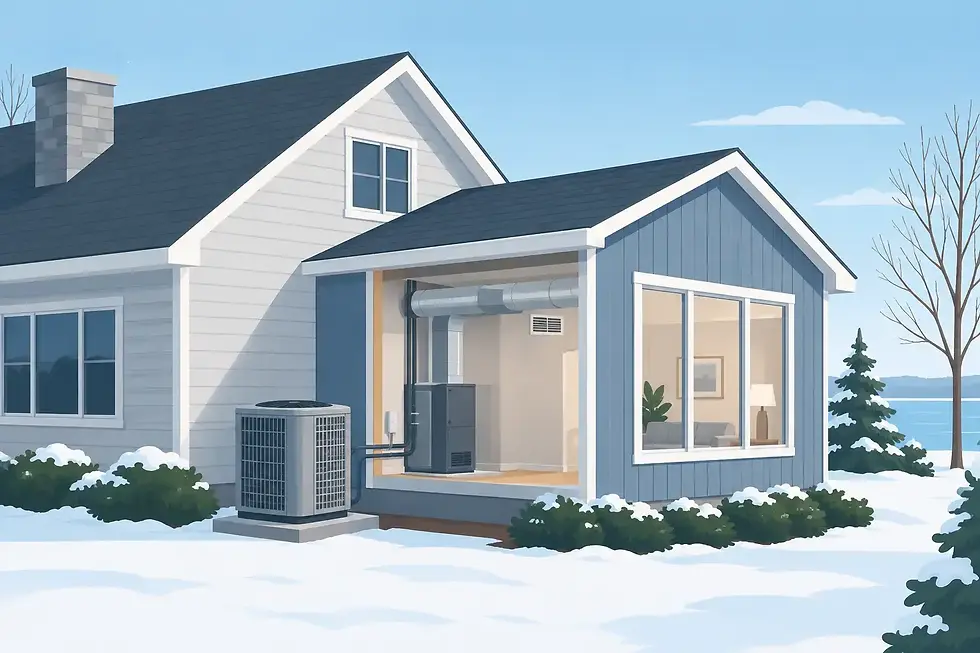
For many finished sunrooms, a ductless mini-split is the most effective and efficient option. It uses a compact indoor air handler and an outdoor unit, delivering conditioned air directly to the room without requiring new ductwork. The indoor unit provides steady cooling where it is needed instead of relying on air pushed from a distant central system.
Mini-splits are especially useful for additions, remodels, and enclosed porches that are difficult to connect to existing ducts. Variable-speed models can adjust their output as the room warms, which helps maintain more even comfort and control humidity during Michigan’s muggy stretches.
The trade-off is upfront installation cost and the visible indoor wall unit. Proper sizing is also critical. An oversized system may cool the room quickly but cycle off before it removes enough moisture, while an undersized unit may run continuously on hot days. Professional load calculations help avoid both problems.
Extending the home’s central HVAC system
If the sunroom is part of a larger renovation or new-home plan, extending the central HVAC system can be a clean, integrated choice. Properly designed ductwork, supply registers, return-air planning, and zoning can allow the room to work with the rest of the house.
This approach makes the most sense when the existing equipment has sufficient capacity or when a system replacement is already planned. It can also preserve a consistent look, with no separate wall-mounted equipment in the room.
However, simply adding one or two supply vents is not the same as designing a complete solution. Sunrooms often need more airflow than a standard room of the same size, and they need a path for return air as well. Without balanced airflow and enough equipment capacity, the room may still run warm while nearby rooms become too cold.
Zoned central air conditioning
A zoning system uses dampers and separate thermostats to direct cooling to different areas of the home. For a sunroom connected to the home’s ductwork, zoning can provide better temperature control than a single thermostat serving the entire floor.
Zoning is most practical when ducts are accessible and the HVAC system is compatible with the added controls. It can be a strong choice for major remodels, larger homes, or spaces where the sunroom’s temperature needs differ significantly from the main living area.
There are limits. Zoning cannot create cooling capacity that the equipment does not have. If the home’s air conditioner is already struggling, a zoning upgrade alone will not correct the issue. The system must be evaluated as a whole.
Window air conditioners and through-wall units
A quality window air conditioner or through-wall unit can provide a lower-cost way to cool a smaller seasonal sunroom. These units are familiar, straightforward, and available in a range of capacities.
They are best viewed as a practical short-term or light-use solution. They can be noisier than installed HVAC equipment, may block part of a window, and typically do less to create even temperatures across a larger room. They also need careful installation to prevent air leakage and water intrusion around the opening.
For a three-season room that is not used every day, this option may be enough. For a sunroom that serves as an office, dining area, or regular living space, a professionally installed system usually delivers better long-term comfort.
Portable air conditioners
Portable air conditioners can help in a pinch, but they are seldom the best primary cooling choice for a sunroom. Most require a hose vented through a window, take up floor space, and can be louder than other options. Single-hose models may also pull warm outdoor air into the room as they exhaust air outside.
A dual-hose portable unit generally performs better than a single-hose model, but neither offers the efficiency, quiet operation, or finished appearance of a mini-split or properly designed central-air extension. Use one when permanent installation is not possible, not as the first choice for a heavily used room.
Do Ceiling Fans and Shades Make a Difference?
Yes, but they support cooling equipment rather than replace it. A ceiling fan creates air movement that helps people feel cooler, allowing the thermostat setting to remain a little higher. It does not lower the actual room temperature, so it should turn off when the room is empty.
Solar shades, insulated cellular shades, exterior awnings, and window film can reduce solar heat gain before it overwhelms the space. Exterior shading is particularly effective because it stops sunlight before it passes through the glass. These improvements can reduce the size of the cooling load and may allow for smaller, more efficient equipment.
For a sunroom with aging windows, poor seals, or limited insulation, addressing the building envelope is part of the cooling plan. Even the right air conditioner will have to work harder if hot outdoor air leaks in around windows and doors.
Choosing the Right Size Matters More Than Most Homeowners Expect
It is tempting to choose cooling equipment based only on square footage. That shortcut is risky in a sunroom. Two rooms with the same floor area can have dramatically different cooling needs depending on their glass area, direction of sun exposure, roof construction, and whether the room is shaded by trees.
A professional assessment accounts for those conditions instead of relying on a broad rule of thumb. This helps prevent oversized equipment, high humidity, short cycling, and unnecessary energy use. It also identifies whether your current HVAC system can safely support an addition or whether a dedicated solution is the smarter investment.
For new construction and major remodels, cooling should be planned before finishes are installed. That gives the project team more options for locating equipment, routing lines or ducts, and protecting the appearance of the finished room.
Comfort Should Extend to the Brightest Room in the House
The best sunroom cooling system is the one that fits how you use the space, not just the hottest day on the calendar. A dedicated mini-split may be ideal for an existing addition, while central HVAC design or zoning can be the right fit for a new build or full remodel. Four Seasons Heating & Cooling helps Michigan homeowners evaluate those choices with expert residential climate-control planning focused on efficient, dependable comfort.
If your sunroom becomes a room you avoid every summer, treat that as a design problem worth solving. The right equipment, properly sized and installed, can turn it back into the place where you want to spend the afternoon.


Comments